

Solar Off Grid and Hybrid Systems
Solar Hybrid Systems combine solar energy generation with battery storage and often integrate with the grid. This configuration offers flexibility, allowing users to store excess energy for use during periods of low solar production or power outages while still benefiting from grid connectivity.
Here's a detailed overview of Solar Hybrid Systems:
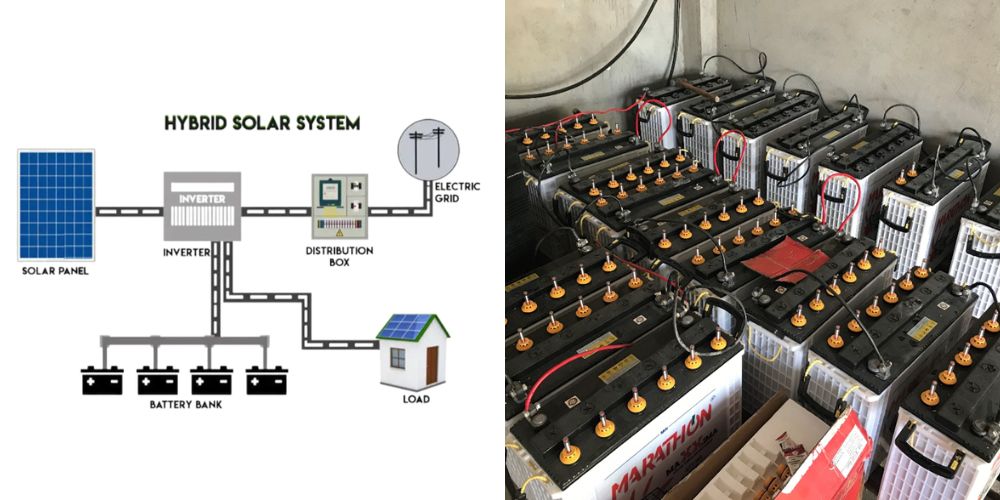
How Solar Hybrid Systems Work
1. Solar Panels:
Photovoltaic (PV) panels convert sunlight into direct current (DC) electricity.
2. Hybrid Inverter:
The hybrid inverter converts the DC electricity generated by the solar panels into
alternating current (AC) electricity compatible with household or commercial appliances.
It also manages the flow of energy between the solar panels, battery storage, and the
grid.
3. Battery Storage:
Excess energy generated during the day is stored in batteries for later use, such as
during
the night or during outages. Battery size depends on system requirements.
4. Grid Connection:
If solar and battery power cannot meet demand, electricity is drawn from the grid. In
some
systems, excess energy can be exported back to the grid for credits through net
metering.
5. Energy Management System:
A smart EMS monitors energy production, consumption, and storage, optimizing the flow
between solar, battery, and grid.
Types of Solar Hybrid Systems
1. Basic Solar Hybrid System:
Features:
• Simple integration with a small battery backup.
• Grid-connected for importing and exporting energy.
• Prioritizes solar use; battery acts as a backup.
Ideal for: Homes or small businesses needing basic backup and savings.
2. Advanced Solar Hybrid System:
Features:
• Large battery capacity for long backup.
• Time-of-use optimization for peak-hour savings.
• Smart home integration & remote monitoring.
Ideal for: Larger homes or businesses needing high energy security.
3. Off-Grid Hybrid System:
Features:
• Works independently from the grid.
• Large battery storage and generator compatibility.
• Ideal where grid access is limited or unavailable.
Ideal for: Remote homes, farms, off-grid locations.
4. Grid-Interactive Hybrid System:
Features:
• Primarily runs on solar + battery power.
• Grid acts as secondary backup.
• Supports net metering and energy arbitrage.
Ideal for: Areas with frequent power cuts, businesses needing
uninterrupted power.
5. Commercial/Industrial Hybrid System:
Features:
• Large-scale systems with advanced EMS.
• Peak shaving, load shifting, demand response ready.
• Ideal for industrial and commercial operations.
Ideal for: Factories, campuses, large buildings.
Benefits of Solar Hybrid Systems
- Energy Independence
- Continuous backup power
- Cost savings during peak pricing
- Sell excess energy to grid
- Reduced carbon footprint
- Customizable for all needs
- Efficient energy management
- Reliable power even in outages
- Ideal for remote areas
- Long-term economical solution
Considerations for Installing a Solar Hybrid System
• Initial Investment: Higher due to batteries and hybrid inverter, but long-term savings are strong.
• Battery Life & Maintenance: Batteries require upkeep and last 7–15 years depending on type.
• System Sizing: Proper sizing of panels, inverter, and batteries ensures maximum performance.
• Local Regulations: Check net metering policies, solar incentives, and installation rules.
Example Scenarios
• Residential: A 10-kW hybrid system with a 20-kWh battery provides energy security and reduces bills.
• Commercial: A 50-kW system stores energy during the day and uses it during peak hours.
• Remote Off-Grid: A 15-kW system with 30-kWh battery and generator backup powers remote farms reliably.
Conclusion
Vincent Energy’s Solar Hybrid Systems offer a versatile and sustainable solution combining solar power, battery storage, and grid connectivity. They deliver energy security, cost savings, and reduced environmental impact for residential, commercial, and industrial use.
Models Available
| S. No. | Model | Capacity |
|---|---|---|
| 1 | VESHS1K | 1KW |
| 2 | VESHS2K | 2KW |
| 3 | VESHS3K | 3KW |
| 4 | VESHS5K | 5KW |
| 5 | VESHS8K | 8KW |
| 6 | VESHS10K | 10KW |
| 7 | VESHS20K | 20KW |